

Fighting Fire with Water
From the Combahee River Collective to the Rainbow Coalition: A Case for Materialist Solidarity

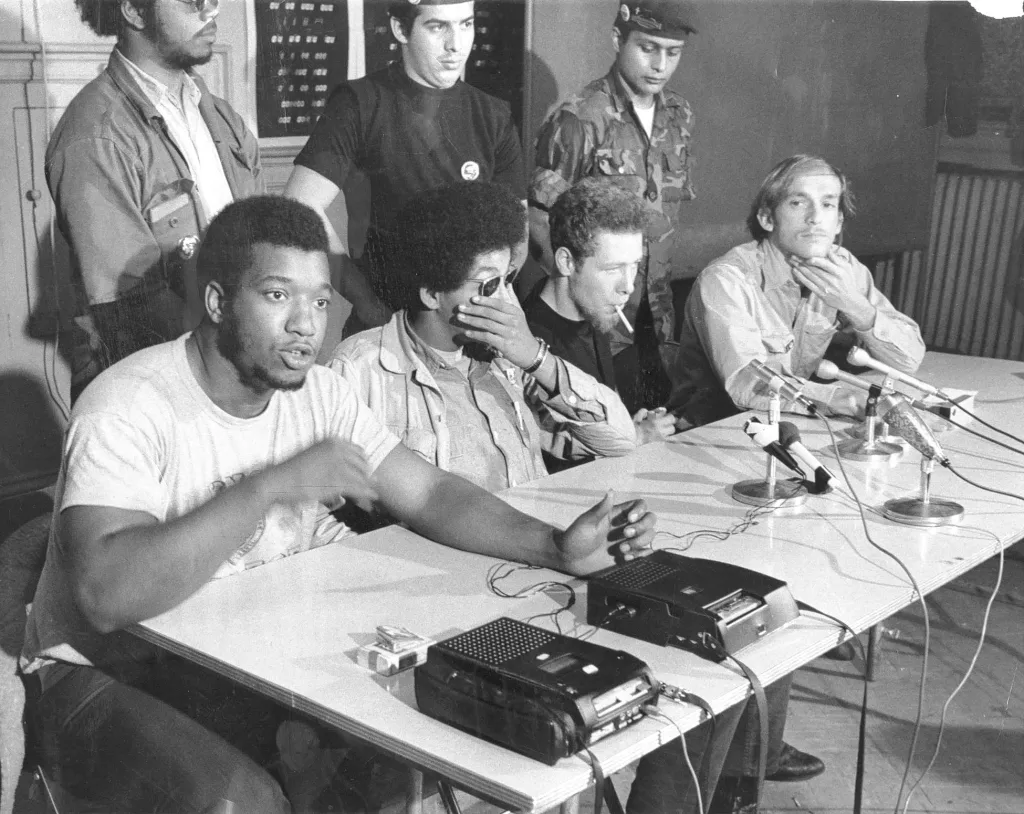
After we get through speaking, for those people of you who don’t think you understood all of the ideology exposed here so far, and the ideologies that I will espouse, we will have a question and answer period. For those people who have their feelings hurt by niggers talking about guns, we’ll have a cry-in after the question and answer period. And for those white people that are here to show some type of overwhelming manifestation of guilt syndromes, and want people to cry out that they love them, after the cry-in, if we have time, we’ll allow you all to have a love-in.
- Fred Hampton, Speech at Northern Illinois University (1969)
Just weeks after Chairman Fred Hampton of the Illinois chapter of the Black Panther Party (BPP) offered these words he was assassinated by officers in direct coordination with the Federal Bureau of Investigation (FBI) and their illegal surveillance program COINTELPRO. His eight-months-pregnant fiancée Deborah Johnson (now Akua Njeri) was being dragged into a different room in Hampton’s apartment when she heard one officer ask: “Is he [Hampton] still alive?” followed by two gunshots and a different officer saying, “He’s good and dead now.”1
Fred Hampton was murdered by the state because he was dangerous to the entrenched order, the political machine pitting people with pennies in their pockets against other people with pennies in their pockets, white people against Black people, Catholics against Protestants, homosexuals against heterosexuals, etc., I can go on. Hampton embodied—he lived—what it means to be at the vanguard of revolutionary struggle, he had an incredibly avant-garde view of the relationship between race and class and identity, always followed his words through in his actions, and helped build a movement that everybody should learn from.
In this essay, I will contrast the revolutionary origins of identity politics—anchored in the socialist framework of the Combahee River Collective—with its contemporary neoliberal distortion to argue that Fred Hampton’s political praxis offers a vital antidote to modern identity divisions. I reason that Hampton advanced a rigorous, materialist conception of race and class that rejects symbolic, superficial, and idealist concessions in favor of tangible, counter-hegemonic power. By analyzing his rhetorical framework and the historical execution of the Rainbow Coalition, I will argue that genuine anti-racism and revolutionary solidarity cannot be achieved through performative moralism or elite Professional-Managerial Class management, but must be forged in the crucible of shared material struggle against the capitalist state.
There Is Identity in Solidarity
One problem immediately reveals itself: what is identity and why does it matter? There are countless definitions of identity, making it difficult to define in such a way that encompasses all of them, thus I offer this definition as the meaning of identity that I’ll be using throughout this essay. Identity is sometimes described as a social construct, but it is more accurate to say that identity is the amalgamation of intersecting social constructs synthesized within an individual or group. It is entirely non-inherent—learned, negotiated, and earned through dialectical self-reflection and sociocultural experience. Identity is critical because it operates simultaneously on two fronts: subjectively, it establishes a psychological sense of self, while structurally, it functions as the terrain where the ruling class secures the hegemony2 and consent of the exploited. Under advanced industrial capitalism, this process becomes further complicated as identity is flattened into a commodified conformity that neutralizes dissent before it even has a chance of forming, what some would call “one-dimensional.”3 Under neoliberal capitalism, identity—through identity politics—is increasingly commodified and incorporated into institutions in ways that often obscure underlying relations of class exploitation.
But this is not what the term “identity politics” originally meant and it would be a disservice to not explore the origin of what has become one of the most controversial buzz-terms of the twenty-first century. It originated with the Combahee River Collective Statement in 1977, a manifesto authored by a group of Black feminist women who organized for the collective liberation of oppressed people through socialism. They wrote:
We realize that the liberation of all oppressed peoples necessitates the destruction of the political-economic systems of capitalism and imperialism as well as patriarchy. We are socialists because we believe that work must be organized for the collective benefit of those who do the work and create the products, and not for the profit of the bosses. . . . We are not convinced, however, that a socialist revolution that is not also a feminist and anti-racist revolution will guarantee our liberation. We have arrived at the necessity for developing an understanding of class relationships that takes into account the specific class position of Black women who are generally marginal in the labor force . . . Although we are in essential agreement with Marx's theory as it applied to the very specific economic relationships he analyzed, we know that his analysis must be extended further in order for us to understand our specific economic situation as Black women.4
For the Collective, “identity politics” was a materialist recognition that their specific positionality—at the intersection of race, gender, and class—gave them a distinct vantage point from which to fight capitalism. Their explicit statement that total liberation necessitates the destruction of capitalism, imperialism, and patriarchy positions them as a revolutionary vanguard: “The major source of difficulty in our political work,” they wrote, “is that we are not just trying to fight oppression on one front or even two, but instead to address a whole range of oppressions.”5 They sum their own position up as follows:
If Black women were free, it would mean that everyone else would have to be free since our freedom would necessitate the destruction of all the systems of oppression.6
In the United States, this is true. Being a melting-pot of different cultural, ethnic, sexual, and gender identities, liberation must reach the most oppressed people because, as they said, the freedom of the most oppressed requires the complete destruction of all the systems of oppression perpetuating the survival of capitalism. They recognized that identity is where, for the lot of us, the most radical politics emerge from, meaning that identity can be, and often is, a driving force of social movements. On identity politics, they say:
We realize that the only people who care enough about us to work consistently for our liberation are us. . . . We believe that the most profound and potentially most radical politics come directly out of our own identity, as opposed to working to end somebody else's oppression. In the case of Black women this is a particularly repugnant, dangerous, threatening, and therefore revolutionary concept because it is obvious from looking at all the political movements that have preceded us that anyone is more worthy of liberation than ourselves. We reject pedestals, queenhood, and walking ten paces behind. To be recognized as human, levelly human, is enough.7
To be truly recognized requires more than liberal recognition: superficial reforms, hiring DEI oppressors, and empty platitudes with no material liberatory substance following it. A true recognition necessitates the destruction of the current hegemonic capitalist society. Luckily, they offer another lesson in that regard.
The final section of the Collective’s statement is titled: “Black Feminist Issues and Projects,” but it provides a profound lesson for white people. They restate their orientation toward politics and activism, before expanding on specific projects they were involved with and the relevant issues they faced:
The inclusiveness of our politics makes us concerned with any situation that impinges upon the lives of women, Third World and working people. We are of course particularly committed to working on those struggles in which race, sex, and class are simultaneous factors in oppression.8
The words above are those of the conscious radical—one that knows their societal position, the history that got them there, and what type of society they want to help build. Their reconciliation of identity as a springboard for revolutionary, anti-capitalist solidarity is in direct contrast with contemporary identity politics, which effectively functions as a barrier, transforming a tool for total liberation into a tool for elite management and institutional assimilation, creating, ultimately, a paradigm where representation within oppressive structures is celebrated, while the structures themselves remain unchanged.
I want to highlight a particular paragraph that remains prescient:
One issue that is of major concern to us and that we have begun to publicly address is racism in the white women's movement. As Black feminists we are made constantly and painfully aware of how little effort white women have made to understand and combat their racism, which requires among other things that they have a more than superficial comprehension of race, color, and Black history and culture. Eliminating racism in the white women's movement is by definition work for white women to do, but we will continue to speak to and demand accountability on this issue.
I take the sentence in bold to mean that in order to not be racist, to purge the racism from yourself so to speak, one must make the effort to understand and combat their own racism and racism in general. I take this requirement to mean that purging oneself of racism is not merely a psychological exercise in moral self-rectification, but a rigorous historical and materialist necessity. To combat racism requires moving beyond superficial empathy and into a deep comprehension of how racial categories were structurally manufactured to fragment, divide, and detain the working class. This is achieved through active political education—studying the histories of racial capitalism, colonial exploitation, and the distinct cultural legacies of oppressed peoples.
For white radicals, learning this history is about stripping away the bourgeois-manufactured prejudices that prevent them from standing shoulder-to-shoulder with Black and Brown comrades. To “not be racist” is to actively refuse to let the ruling class use your skin color as a wedge to break solidarity. It is the realization that the elimination of racism is fundamentally and inseparably tied to the elimination of the capitalist system that feeds on it.
Chairman Fred self-identified as a Marxist-Leninist, in his speeches he invoked frequently the names of Vladimir Lenin, Che Guevara, Mao Tse-Tung, and other great revolutionaries. Hampton understood that racism profoundly shaped Black life in America, yet he also understood that racial oppression was reproduced and maintained through a broader capitalist order that benefited from division among the exploited.
He recognized earlier than many how working class people are pitted against one another over the very real consequences of social divisions and histories of oppression, a mechanism that fragmented working-class solidarity. He understood that, while he was absolutely being discriminated against and oppressed, and, that, even though the white skin frequently accompanied the oppressor, he was fundamentally enslaved by the hegemony of capitalism. What set Hampton apart from others was his active and vocal rejection of political approaches that elevated symbolic recognition, racial exclusivity, or personal affirmation above mass organization and collective struggle. In his words:
We know that in order to be able to talk about power, that what you’ve got to be able to talk about is the ability to control and define phenomena and make it act in a desired manner. That means that if you can’t control and define phenomena and make it act in a desired manner, then you don’t even have any dealings with power, you don’t know and you probably never will know what power is. And we know what power is, and we know who’s doing harm to the people—the enemy.9
For Hampton, power is not something to be taken, it is something you build. It does not manifest through the superficial inclusion of marginalized faces in high places, nor does it exist in the performance of psychological absolution. In the context of contemporary identity politics, “power” is frequently reduced to discourse, linguistic policing, and representation within the bourgeois apparatus. Hampton completely rejects this idealist framework. To him, if you cannot fundamentally alter the material conditions of the people, if you cannot make the political and economic phenomena “act in a desired manner,” you are merely playing at politics.
That the conflict is fundamentally a class struggle is the crux of his declaration. When identity is weaponized to obscure material reality, it plays directly into the hands of what Hampton called “the enemy.” By defining power through the lens of control and direction, Hampton draws a sharp boundary line between revolutionary organizing and reactionary division. He understood that the ruling class is perfectly content to concede cultural recognition, diverse hiring metrics, or symbolic apologies, precisely because these concessions leave the underlying structures of capitalist exploitation completely untouched. True power requires a united front of the exploited, a reality that cannot be achieved if the vanguard remains fractured by the very social divisions the state relies upon to maintain its hegemony.
The Vanguardism of the Rainbow Coalition
It was through this materialist conception of power, race, and identity that Hampton translated revolutionary theory into historical praxis, helping to build what was perhaps the most radical experiment in multiracial working-class solidarity in United States history: the Rainbow Coalition.
To build true power, Hampton knew he had to confront the racism systematically cultivated to fracture Chicago's working class. Nowhere was this challenge more stark than in the Black Panther Party’s alliance with the Young Patriots Organization (YPO). The Patriots consisted largely of poor white migrants from Appalachia and the American South who had been displaced by economic restructuring and pushed into the slums of Uptown.
Like Black and Brown working class people in Chicago, they faced severe poverty, substandard housing, and rampant police brutality, yet they also clung to deep-seated racial prejudices, going so far as to adopt the Confederate battle flag as their official symbol. Rather than ignoring or excusing these prejudices, Hampton understood them as historical products that could be overcome through common struggle, political education, and participation in shared institutions of working-class power.
An alliance between a Black revolutionary vanguard and a group of Confederate flag-waving white southerners was deemed a structural impossibility, an ideological betrayal. But Hampton understood that identity politics only serves to freeze people in their bourgeois-assigned categories. He looked past the reactionary symbolism to the shared class exploitation beneath it. The task of the revolutionary, as Hampton saw it, was not to retreat from people poisoned by reactionary ideas, but to organize among them, struggle alongside them, and, through collective action and political education, transform their consciousness. He summarized this anti-sectarianism beautifully, declaring:
We got to face some facts. That the masses are poor, that the masses belong to what you call the lower class, and when I talk about the masses, I’m talking about the white masses, I’m talking about the black masses, and the brown masses, and the yellow masses, too. We’ve got to face the fact that some people say you fight fire best with fire, but we say you put fire out best with water. We say you don’t fight racism with racism—we’re gonna fight racism with solidarity. We say you don’t fight capitalism with no black capitalism; you fight capitalism with socialism.10
The transformation of consciousness within the coalition was neither instantaneous nor without deep friction. When Black Panther Field Secretary Bob Lee first entered the Young Patriots’ headquarters in Uptown, he was met with rooms draped in the Confederate battle flag.11 Rather than retreating into ideological purity or demanding the Patriots stop donning the flag, Lee and Hampton engaged them on the terrain of class—what Hampton would call objective—reality.
They challenged the Patriots to recognize that the flag of their oppressors—the Southern ruling elite—was being used as psychological bribe to keep them blind to their own poverty. Through rigorous debate and joint actions against corrupt slumlords and brutal police precincts, the Patriots underwent a profound ideological shift. They began wearing the Confederate flag alongside Panther buttons, eventually phasing the flag out entirely as their reactionary cultural identity was swallowed by a revolutionary class consciousness.
This orientation represented a profound break from both liberal moralism and racial chauvinism. Hampton rejected the notion that solidarity could be built through guilt, symbolic gestures, or abstract appeals to tolerance. Likewise, he rejected the idea that liberation could be achieved through separatism or the inversion of racial hierarchies. For Hampton, solidarity was a revolutionary necessity.
The alliance between the Black Panthers and the Young Patriots was a conscious strategic intervention into the contradictions of American capitalism. The Panthers and Hampton recognized that the same economic system that confined Black Chicagoans to segregated neighborhoods and subjected them to constant police terror had also displaced thousands of poor white Southerners, relegating them to decaying slums. Their experiences were not identical—far from it—but they were linked by a common relationship to exploitation and state repression.
This shared relationship to exploitation was addressed through concrete, material infrastructure. Under Hampton’s and Lee’s guidance, the Rainbow Coalition replicated the Black Panther Party’s Survival Programs across racial lines. YPO established a Free Breakfast for Children program and a free health clinic for poor white residents, directly modeled on and supported by the Panthers’ initiatives. Similarly, the Young Lords took over institutions in their neighborhoods to provide daycare, food, and medical services to Puerto Rican families. By anchoring the coalition in the literal survival of the community, Hampton demonstrated that solidarity is built through shared labor and mutual aid, completely bypassing the modern identity politics model that prioritizes purity over material relief.
Through sustained engagement, shared campaigns, and political struggle, Hampton and the Panthers demonstrated that these divisions could be overcome. The Rainbow Coalition united the Black Panthers, the Young Patriots, and later the Young Lords Organization, a revolutionary Puerto Rican organization, around concrete struggles; police brutality, inadequate housing, poverty, hunger, and political disenfranchisement. They did not demand that people abandon their histories or identities. Instead, they sought to transform those identities into the basis for a broader revolutionary consciousness rooted in the common struggled against capitalism and imperialism.
It was precisely this cross-racial, class-conscious vanguardism that marked Fred Hampton for death. The entrenched political machine and the Federal Bureau of Investigation were entirely unbothered by fractured, race-first nationalist groups that self-segregated. However, a unified front of Black Panthers, armed Southern whites, and radical Puerto Ricans explicitly targeting the capitalist state was an existential threat to ruling-class hegemony. COINTELPRO documents explicitly noted the fear of a “Messiah” who could unify the various factions of the radical left.12 By assassinating Hampton, the state sought to decapitate the Rainbow Coalition, recognizing that if the multi-racial working class ever realized and acted on their shared material interests, the entire capitalist apparatus would crumble.
Conclusion: The Prescience of Class Solidarity
Fred Hampton’s greatest contribution was that he demonstrated, in practice, how identity and solidarity are not contradictory forces. Identity can be the source of our most profound and radical politics, but only when it is transformed into collective struggle against the social relations that perpetuate oppression in the first place. Hampton understood, much like the Combahee River Collective would later articulate, that race, class, gender, and other forms of oppression cannot be artificially separated from one another. Yet he also understood that capitalism survives precisely by fragmenting the oppressed into competing and isolated constituencies incapable of ever exercising real power.
It is a tragedy of contemporary politics that identity has increasingly been severed from questions of power, class, and social transformation. In its dominant institutional forms, identity politics has been stripped of its revolutionary content and repackaged into a politics of shallow representation, symbolic inclusion, and elite management. We are told that liberation can be achieved through diversity initiatives, corporate appointments, carefully curated language, or the elevation of marginalized individuals into positions within existing institutions. Hampton rejected this. He understood that genuine liberation cannot be found in the superficial diversification of oppressive structures, but only in their radical reconstruction.
The Rainbow Coalition remains one of the clearest historical examples of what such reconstruction requires. The Panthers, Young Patriots, and Young Lords did not overcome their differences by pretending those differences did not exist. Nor did they reduce politics to the management of identity. Radically, they recognized that their distinct histories of oppression were rooted in a common political-economic order and that only through organization, political education, mutual aid, self-and-mutual community defense, and shared struggle could they build the power necessary to challenge it. They forged their solidarity with each other through concrete campaigns, direct action, and the construction of institutions capable of sustaining life itself.
These lessons are no less relevant today. The twenty-first century is characterized by staggering inequality, declining living standards, political polarization, and the continual weaponization of identity by both ruling elites and reactionary movements. Workers are constantly pitted against one another along lines of race, nationality, gender, sexuality, religion, and immigration status while wealth and power become evermore concentrated in fewer hands. The same strategy of divide, isolate, and hegemonize is used, albeit through new mechanisms, but the tactic is unchanged.
To return to Hampton’s 1969 address at Northern Illinois University is to see a prophetic critique of our current political stagnation. Hampton fiercely rejected the “cry-ins” and “love-ins” of performative, guilt-driven activism because he understood that capitalism and a capitalist state cannot be shamed into abdication, it must be structurally dismantled through the construction of mass counter-hegemonic power.
Modern radicals must therefore confront a difficult question: are we interested in recognition, or are we interested in power? If we are interested in power, then we must recover Hampton’s revolutionary orientation. We must learn to organize across difference without erasing it, combat racism without surrendering to sectarianism, and build real institutions capable of transforming the material conditions of ordinary people. We must move beyond politics as performance and return to politics as struggle!
The state murdered Fred Hampton at twenty-one years old because it understood something that many radicals today have forgotten, a politically conscious, organized, multiracial working class is among the greatest threats to the existing order. More than fifty years has passed, but Chairman Fred’s challenge remains before us. He proved his vision was possible. We all must ask ourselves: Do we possess the courage, discipline, and revolutionary imagination necessary to build it again?
The ultimate lesson of Chairman Fred is that solidarity is not born from an alignment of cultural aesthetics, but forged in the crucible of shared material struggle. Only when the exploited refuse to let the ruling class use their identities as a wedge can they build the genuine, unyielding class power required to make history act in the interest of the masses.
Alicia Maynard, “The Assassination · the Assassination of Fred Hampton · Digital Chicago,” digitalchicagohistory.org, accessed June 26, 2026, https://digitalchicagohistory.org/exhibits/show/fred-hampton-50th/the-assassination.
For a detailed exposition of cultural hegemony, I recommend Antonio Gramsci’s Prison Notebooks and my article:

Referring to Herbert Marcuse’s One-Dimensional Man.
Combahee River Collective, “The Combahee River Collective Statement,” accessed June 26, 2026, https://americanstudies.yale.edu/sites/default/files/files/Keyword%20Coalition_Readings.pdf,5.
Combahee River Collective, “Combahee River Collective Statement,” 7.
Ibid., 7.
Ibid., 4.
Ibid., 10.
Fred Hampton, “It’s a Class Struggle, Godamnit!,” 1969, in Marxists Internet Archive, https://www.marxists.org/archive/hampton/1969/11/class-struggle-godamnit.htm (accessed June 26, 2026).
Fred Hampton, “Power Anywhere Where There’s People!,” 1969, in Marxists Internet Archive, https://www.marxists.org/archive/hampton/1969/misc/power-anywhere-where-theres-people.htm (accessed June 26, 2026).
Jakobi E. Williams, “An Arc of Solidarity: Remembering Bob Lee (1942-2017),” viewpointmag.com, March 29, 2017, https://viewpointmag.com/2017/03/29/an-arc-of-solidarity-remembering-bob-lee-1942-2017/.
“FBI Counterintelligence Program - Black Nationalist,” umich.edu, accessed June 26, 2026, https://policing.umhistorylabs.lsa.umich.edu/files/original/76f92e7fcb615da7da6b92e1ea8ede51f5d653b3.pdf.
Being a middle class child of the sixties I was brought up to fear these revolutionary forces and the language of revolution still has the power to invoke a vestige of that fear. Yet I have believed for decades that we are none of us better than anyone else. This essay articulates so clearly this feeling I have always had and breaks through the conditioning that made the revolutionary words something to fear - to hear the words as they were meant rather than as interpreted by the class I inhabited.
Thank you. I always enjoy your writing but this has struck home in a particular way.
Hello, I just wanted to give my flowers on your post! Not only was it well written, but it really helped recontextualize my understanding of the concept of identity politics by tracing its origins to Fred Hampton, The Rainbow Coalition, and The Combahee River Collective movement, serving as a reclamation of the definition, its history, and the hope of the future it can achieve. I always looked at identity politics with an air of suspicion or just a negative light altogether as a performative digestion of inclusion not really serving the interests of the groups in question but more for the culture and system it occupies and reproduces. I like how you put its reconfiguration as a “contemporary neoliberal distortion.” Inclusion gives a false sense of belonging, but it does not care about the oppressed. It is swallowed into its belly as another tool for the oppressor to further its reach and protect its empire. More dangerously, identity politics can be a method of division within the oppressed and working class itself, so the marginalized cling to the escape and superiority of climbing up in a class and system that is self-serving and exploitative, either assimilating or participating in a constant loop of suffering, confused as purpose.
But, I didn’t really think of it as anything other than the distortion displayed because the practice of it is so prevalent and its history so buried. But Identity is the context, the trace, a layer of consciousness needed to point to where we specifically are exploited and expose it, and more importantly, coordinate the steps to combat it as a collective, embracing the struggle and unity of solidarity. Every method of oppression must be investigated and extinguished for total liberation.
I also found the way Hampton looks at power to be quite admirable, not to be taken, but to be built and directed as you stated in your post. Altering material conditions rather than playing a part in it.