

Stop Being a Spectator
The Red Scares trained Americans to accept repression as patriotism.

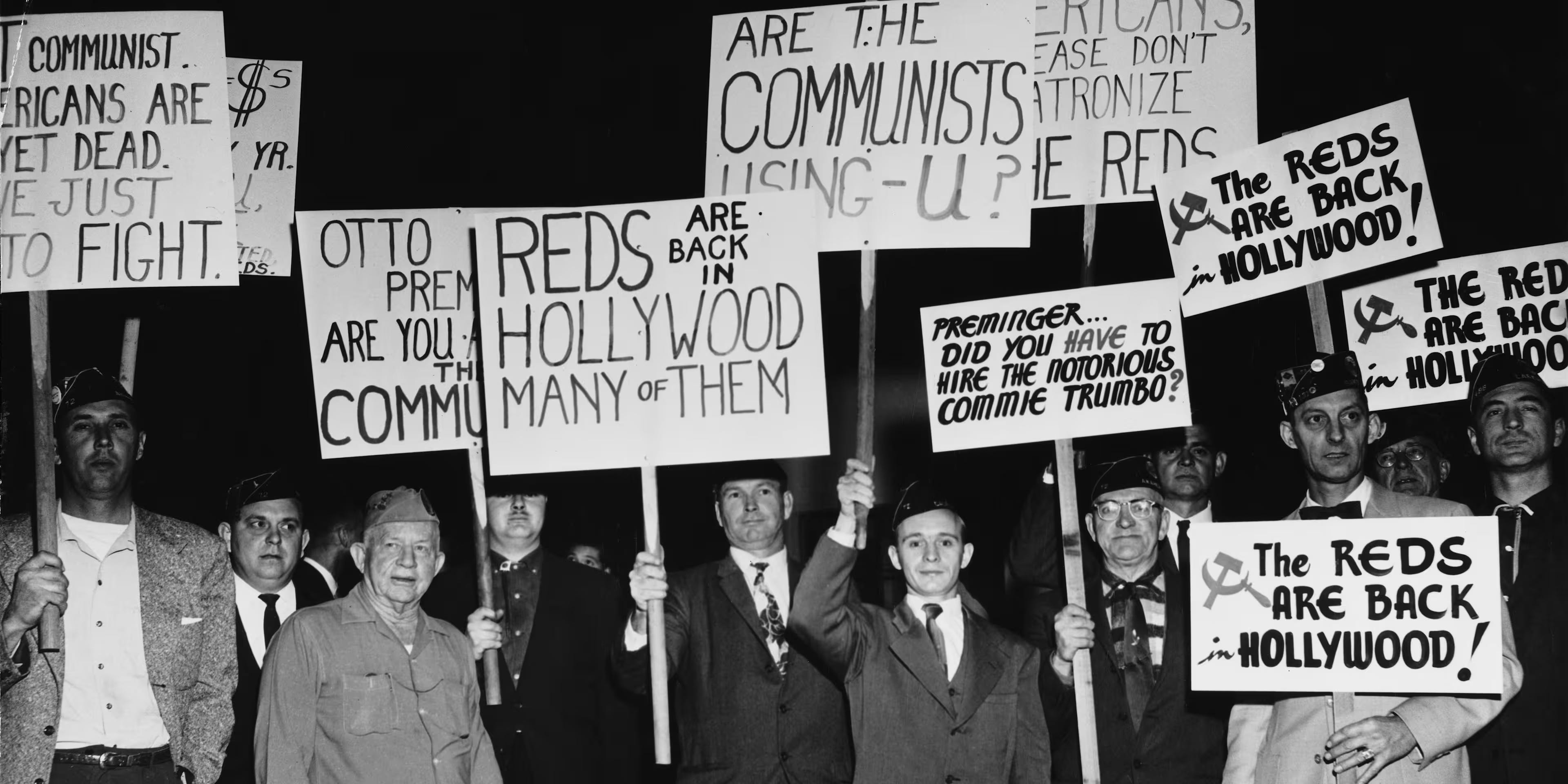
A particular recent interest of mine has been diving back through the history of the Red Scares. It’s important that we remember the virulent anti-Leftism of the twentieth century so we can shed ourselves of the propaganda of the past and look forward to the future that we are actively building. Even the spectators, those who aren’t believers in their power or the collective power of the working-class, are actively placing the bricks of the foundation of that future. Unfortunately, spectators have always existed and they’ve always played a part in steering the future.
The spectators in the twentieth century, the ones who saw lynchings in the South, who sat back in the galleries during the many testimonies of ordinary people who were guilty of the dirty crime of espousing Communist and Socialist views, who were the target audience of Dr. King’s “Letter from Birmingham Jail,” who refused integration and defended segregation, are the same spectators who saw the election of a Black man in 2008 as an attack on Americanism, are the same spectators who saw Congress hold up funds for the children, the vast majority of them minorities, of Flint exposed to lead because of decades of policy meant to divide the city among racial lines rather than rebuild it.
We cannot be spectators; we must break down the lies and reveal the truth: capitalism depends on keeping the working-class divided through race, gender, sexuality, and ideology. The Red Scares are two of the most defining and divisive periods in American history. In order to understand just how destructive these campaigns were, we have to go back over a century and analyze how the United States government crusaded against solidarity and set the conditions for segregation within the working-class amidst a rising, interracial labor movement.
“Americanism” as Disguise for Racism
The Red Scares were not accidental or spontaneous. They were long campaigns that were well-funded, backed by federal and state institutions, deliberate in their intention, and enforced both by force and by the legal system. They were manufactured moral panics meant to make ordinary people afraid of each other, to make the language of class feel like the language of treason, and to make the most basic acts of self-defense, such as tenants, workers, and neighbors organizing, look like a conspiracy to overthrow the state. But why do such organizations form in the first place? When people are exploited it is only rational to come together with those who share in your suffering, with those who know and understand your struggle.
In the United States, the ruling class—the owners and controllers of capital, the major employers and institutions that profit from exploitation, the state managers who defend that order—has always depended on isolating the so-called “militants,” splitting the working-class along artificial lines, and calling that split common sense. The powers that be have long-ago figured out that the country does not need to be convinced that employers are angels. What they knew they had to convince people of was much more simple: solidarity is suspicious, and those who speak most clearly about solidarity are not really us, not truly American, not members of our communities, and not really worthy of rights.
Once you can label a worker simply trying to get by as a threat to the nation, you can do almost anything to them and still claim you are defending freedom.
This is why “Americanism” has always been a loaded term. It has always meant something like innocence, loyalty, and belonging, and those meanings have always been racialized. When someone was hit with the label “un-American,” they were being marked by a state hellbent on deciding who gets to exist in public life without being treated as a suspect.
This becomes very clear when you examine the tools, instruments, and mechanisms of the Red Scares. Raids, deportations, loyalty oaths, blacklists, firings, illegal surveillance, tracking and infiltration, trumped-up prison sentences, and state violence were used to squeeze the life out of organizations that taught workers they did not have to live like this. The state made an example out of “radicals” and, in doing so, sent a message to everyone else: if you stand too close to them, if you openly organize, if you speak clearly and people listen, you can and will be made into a criminal and a stranger overnight.
Race made the threat easier to sell because race has always been the easiest way to turn a neighbor into a nemesis and then pretend the hatred is natural. It conditioned spectators to see certain people as permanent suspects, to hear certain demands as permanent threats, and to treat state repression as protection even when it is so obviously punishment.
It made it possible to say that strikes were not workers fighting back against exploitation, but mobs being manipulated by swindlers selling fantasy; that organizing while Black is not community-defense, but insurrectionary agitation; that immigrants aren’t regular people just trying to survive, but literally “aliens” bringing crime and dangerous ideas; and that interracial organizing isn’t solidarity, but an act of treachery against one’s race.
In other words, the Red Scares did not just attack Socialism. The Red Scares attacked the conditions under which Socialism becomes thinkable: trust, organization, shared struggle, and the recognition that the working-class is one class no matter how many lines are drawn inside it.
The United States crusaded against Communism because the state understood, better than most spectators ever have, that solidarity is power, and power is the one thing that capital cannot cede to workers because, if it happens, the capitalist system will implode on itself.
When we return to a century ago, we shouldn’t waste our time looking for moments where America “lost her way;” rather, we should be looking at the moments when the ruling class found ways to weaponize race against collectivism and to mechanize the state to keep the working-class divided in the name of patriotism.
The Invention of the “Alien Radical”
Far from stumbling into the Red Scares by accident, the U.S. government manufactured a category that made repression easy to justify and even easier to cheer for: the “alien radical.” This label, a political invention, was built specifically to be returned to again and again by the ruling class whenever working people begin to organize in ways that threaten the established order.
The genius of the category is quite simple. It translates class struggle, workers demanding bread, safety, and control over their lives, into a foreign language. Once this translation happens, the state no longer needs to debate workers’ demands. It now only needs to remove the worker, silence the organizer, raid the meetings, deport the so-called “radical alien,” and call it national defense.
Anti-communism pairs tremendously well with racism and nativism. The “alien radical” was always about who gets to be treated as a full person and who can be reduced to a threat—someone the state can imprison or expel with minimal backlash. In practice, “alien” did what it has always done in American politics: it marked people as disposable, placed them outside the moral community, and told the spectator that whatever happens next is not cruelty, but necessity.
And what happened next was force.
Raids on meeting halls and homes; mass arrests; people held without basic legal protections; families torn apart; workers and organizers removed from the workplaces and neighborhoods where they had influence; deportations framed as necessary for national defense. The “alien radical” was the state’s way of turning the working-class into a set of suspects and solidarity into something shameful, something dangerous to be near.
The function of all this was to break the conditions that make working-class organization possible, force people to choose between their livelihood and their beliefs, teach communities that political speech is safe only when it is harmless.
Returning to the spectator, the category only works if enough people accept it. It requires an audience trained to believe that the state does not target innocents, that punishment is proof, that anyone called “subversive” must have done something to deserve it. It requires people who, when they hear “alien,” do not think neighbor or coworker, but intruder. Once that mental shift occurs, repression becomes the norm.
The “alien radical” is only the early form of a repeating method: create a category of suspects, tie it to foreignness and disorder, then use it to criminalize collectivism.
The “Alien Radical” Becomes the Blueprint
A category is only useful when it can be turned into a procedure, so that repression stops looking like an exception and starts looking like routine. That’s what the early Red Scare accomplished. It built a workflow for how to do political repression in a country that claims to be free.
The first step is crucial: build the legal scaffolding. The state leaned on wartime and post-war frameworks that treated dissent as a security problem. It isn’t necessary to outlaw “solidarity” explicitly; you just need a legal framework where speech, association, and agitation can be reframed as danger when the wrong people do it. This means that the state could target meetings, newspapers, and organizers, and treat them as threats that needed to be neutralized.
The next step was administrative, and it was just as important as the legal one: build the files.
Once the state decides that “radicals” are not citizens exercising rights but threats requiring neutralization, it immediately begins doing what bureaucracies do best—collecting names, addresses, affiliations, newspapers, meeting locations, donation lists, union connections, printing presses, and personal relationships. This is how repression becomes scalable. You don’t need to “prove” guilt in the moral sense when you have a paper trail that can be reinterpreted as evidence. You don’t need a conviction when you can brand someone a suspect, and you don’t need a suspect to commit a crime when you can treat association as the crime itself.
The so-called justice system gives the state permission, the files give it capacity. The demonstrations of force follow naturally. The raid is a public performance meant to teach everyone watching what is allowed. It teaches the organizer that their space can be entered at will by the state; it teaches the sympathizer that being near you carries a cost; it teaches the broader community that political organization is not a right, it is a risk.
But the most useful tool of all for a country that pretends to love liberty is the border.
Deportation is the perfect weapon because it bypasses the entire moral theater of democratic rights. You can “debate” a policy. You can “argue” with a demand. You cannot argue with removal. Removal is elimination. And once deportation becomes a normal political response, the message to immigrant workers is unmistakable: you may labor here, but you do not truly belong here, and your existence will be tolerated only as long as it is harmless.
To make part of the working-class deportable is to make it more exploitable by design. The threat of removal pressures wages downward, weakens bargaining power, and makes open organizing feel like an act of self-destruction. It turns survival into silence. Even workers who are not deported absorb the lesson because repression rarely needs to reach everyone to be effective. It only needs to reach enough people that fear does the rest.
This is why Americanism mattered so much. It did not educate the public about economics; it educated the public about belonging. It trained people to interpret state violence through a simple moral shortcut: if they are being targeted, they must not be one of us.
And, crucially, it shows the ruling class how to recruit spectators into consent by making them fear militants; by making them worship “America”; by smearing solidarity with foreignness and danger until people are ashamed to stand too close to it.
The language will change, the targets will expand, the legal codes will evolve, but the logic remains the same: build a suspect category, tie it to disorder and foreignness, institutionalize surveillance, punish association, isolate organizers, and call it freedom. The First Red Scare taught the state how to do this with raids and deportation. The Second Red Scare would take the same method and embed it deeper—into workplaces, unions, schools, and the everyday conditions of employment—so that repression wouldn’t only happen in the streets, but in paychecks, hiring decisions, blacklists, and the slow strangling of working-class organization from the inside.
Repression in the Workplace
In the Second Red Scare, the state did not need to deport you to destroy you. It could simply make you unemployable. It could deny you work, deny you security, deny you credibility, deny you access to public life, and it could do it all through “respectable” institutions that claimed they were only protecting the nation from danger. The loyalty oath; the security clearance; the background checks; the hearing; the blacklist. These mechanisms did not have to prove you guilty of anything meaningful. They only had to mark you as a suspect. Once you are marked as suspect, the system doesn’t need to imprison you to neutralize you. It can starve you socially and economically until you are forced to disappear on your own.
The Second Red Scare is crucial for understanding how power works. The state set out to terrorize the boundary of acceptable politics, make workers self-censor, condition neighbors to fear each other, make unions cautious, internally divided, and loyal to the system that keeps them in chains.
Under this regime, your livelihood depends on proving your loyalty, and loyalty is not defined as love for your fellow worker; it is defined as submission to the political order. “Freedom” is recoded as obedience; rights become conditional. You are allowed to exist publicly, to work publicly, to teach publicly, to organize publicly, only if you can be trusted not to disrupt the smooth reproduction of capitalist life.
A person can be fired not because they failed at their job, but because they failed at political conformity. A teacher can be purged not because they harmed students, but because they harmed the narrative. A worker can be blacklisted not because they stole from the employer, but because they spoke too clearly about exploitation. The Second Red Scare operationalized the same logic as the first: you do not refute the demands of the working-class; you disqualify the people making them.
Once repression is filtered through employment, it reaches deeper than any raid ever could. A raid hits a meeting; a blacklist hits a life. It reaches into rent, groceries, childcare, healthcare, family stability, reputation, and future prospects. It makes the cost of politics immediate and personal. It encourages the spectator mentality not through ignorance, but through fear: I can’t afford to get involved. I can’t afford to be seen. I can’t afford to be associated.
And now, to return to the question of racism, we have to see what this does inside the working-class. A purge regime always has an internal logic: it requires people to prove they are “safe.” But safety is never defined neutrally. It is defined by the dominant order and in the United States, that order is racialized. “Respectable,” “loyal,” and “American” are never purely political terms. They are cultural terms. They are social terms. They are terms of belonging.
So when unions, workplaces, schools, and civic institutions begin purging “subversives,” they are not merely purging an ideology. They are purging the people most likely to challenge the whole structure, including the racial structure that capitalism depends on to divide labor and dampen solidarity. This is one of the quiet historical tragedies of the era: the forces that were most willing to organize across racial lines, most willing to link exploitation to racial domination, most willing to treat the working-class as a single class, were exactly the forces that anti-communism targeted as uniquely dangerous.
And the “spectators” of this era, again, are not passive background characters. They are the necessary audience. The blacklist only works if ordinary people accept its premise: that suspicion is evidence, that accusation is proof, that the state is only targeting the guilty, that anyone punished must have earned it. The hearing only works if the public treats humiliation as justice. The loyalty oath only works if the public believes rights should be conditional.
The Second Red Scare reshaped the moral “common sense” of the country. It taught people to equate political courage with irresponsibility. It taught them that safety comes from distance—distance from militants, distance from radicals, distance from anyone who names capitalism too directly, distance from anyone who insists that racism is not an unfortunate flaw in the system but one of its operating principles.
When that lesson takes hold, the ruling class doesn’t have to rely on brute force alone. The workplace will do the policing. The union bureaucracy will do the policing. The school board will do the policing. The landlord will do the policing. Neighbors will do the policing. People will begin to preemptively silence themselves. This is what I mean when I say repression is so normalized, so ingrained into the fabric of what we assume it means to be an American, that some are willing to defend the most blatant abuses of state power.
That sets the stage for what comes next, because once the state and the public have learned to treat anti-capitalist politics as disqualifying, it becomes incredibly easy to treat anti-racist politics the same way, especially when anti-racist politics begins to threaten property, policing, and the racial order that underwrites “Americanism” itself.
The Lesson of the Red Scares
By now the pattern should be unmistakable.
The Red Scares were never simply a backlash against an ideology. They were not a series of unfortunate misunderstandings in an otherwise healthy democracy. They were campaigns of social discipline coordinated through law, enforced through police power and employer power, normalized through media and “common sense,” and justified through a national mythology that has always been racialized.
The First Red Scare manufactured the “alien radical,” and in doing so it solved a problem that every ruling class faces when the exploited begin to organize: how do you crush solidarity without admitting you are crushing solidarity? The answer was to translate class struggle into foreignness. To turn a worker demanding bread into an intruder undermining the nation. To make removal look like defense. Once that category existed, repression could be administered: files built, meetings raided, organizations disrupted, deportations carried out, and spectators could be trained to interpret it all as necessity rather than violence.
The Second Red Scare then took that same logic and embedded it deeper. It moved repression out of the headline spectacle and into the daily machinery of life. It made loyalty a credential and employment a weapon. It created a world where you could be neutralized without bars or chains simply by being marked, isolated, made unemployable, and turned into an example for everyone else. In that environment, the state didn’t need to convince the public that capitalism was good; it only needed to make dissent too costly to practice.
Across both eras, “Americanism” was the disguise that made it all feel righteous. But it wasn’t only disguise. It was governance. It taught spectators what to fear, who to suspect, and which kinds of suffering were undeserving of sympathy. It trained people to equate obedience with maturity and militancy with danger. It made political rights feel conditional, something to be earned through conformity rather than something inherent to human beings.
None of this was racially neutral.
Racism is not an accessory to American capitalism; it is one of its operating principles. It segments the working-class, it disciplines labor, it manufactures scapegoats, and it supplies the moral language that makes coercion sound like protection. The Red Scares actively used racism and nativism as tools to decide who belongs, who can be treated as a full person, who can be denied rights, who can be removed, and who can be crushed without the country feeling like it has done anything wrong.
The “alien radical” label did this openly. It placed immigrant workers outside the moral community and turned deportation into a political solution. The blacklist did it more quietly. It created a standard of “respectability” and “loyalty” that was never separate from race, never separate from class position, never separate from the demand that people prove they are safe by distancing themselves from the very solidarities that could liberate them.
Every purge has two targets: the people being punished and the people being trained. The punished learn fear; the trained learn consent. And the trained are taught, again and again, to identify with the nation rather than with the class.
Spectatorship is the role capitalism needs the majority to play when the state moves against solidarity: watch, doubt, rationalize, and move on. Spectators are the ones who say, If they were targeted, they must have deserved it. Spectators are the ones who mistake punishment for proof and security for morality. Spectators are the ones who accept division as natural because unity would require confronting what capitalism actually is.
But history also shows something else: spectatorship is not destiny.
The Red Scares were powerful precisely because solidarity is powerful. The state built files and blacklists because workers organizing together threatens the entire foundation of capitalist rule. When the working-class begins to see itself as a class, when it begins to recognize that exploitation is shared, that suffering is patterned, that the lines drawn inside the class are artificial and useful to the people at the top, capital has no answer that is stable. It’s response is to delay, repress, divide, and silence.
The Red Scares teach us that the ruling class will always move to criminalize the solidarities that threaten it, and it will always do so through the language and machinery that are most effective at dividing the working-class. In the United States, that means “Americanism.” It means racism; it means constant attempts to turn collectivism into conspiracy, and to turn the most basic truth: that the working-class makes society run, into something unspeakable.
If we do not want to repeat this history, we cannot treat the Red Scares as a closed chapter. We have to recognize the method when it reappears. That is why we cannot be spectators.
The future is built, first and foremost, by people who act, but it is also built by the people who watch repression and accept it as normal. The Red Scares were a crusade against solidarity, and their deepest injury was not only to the people arrested, fired, deported, and imprisoned, but to the social imagination of the working-class—to the sense that we can trust each other, fight together, and win together.
But solidarity is not treason. It is survival; it is self-defense; it is the very beginning of freedom.
Maybe it's worth noting that spectatorship and racism aren't the only or perhaps even best ways to sow division. Liberal "anti-racism" (race-reductionism) asks us to actively police each other and creates divisions that way.
Excellent essay. I think spectators can also be mobilized for reactionary ends on the part of the state. The concept of the silent majority comes to mind. In my study of teacher union history I refer to them as the public boss class—the 1974 Hortonville Teachers' Strike is an especially good example of how they construct their identifies and what types of political action they then take. They're also the ones taking over school board meetings and pushing for book bans over CRT and LGBTQ+ characters. Americanism definitely plays a large role in the identify of a public boss class, as it does for spectators in general.